Understanding and recognising fatigue in horses
What is the fatigue?
In the context of equestrian sports, we describe fatigue as follows: the inability of a horse to keep performing at the desired level.
This reveals itself by a horse becoming slower or unable to jump as high or lesser movements in the course of a training , trial or race. Fatigue in this context is different from exhaustion, which can lead to an inability for a horse to even take another step or stay upright. Fatigue is a protective mechanism that prevents a horse from continuing to a point where it damages itself. In general, , the harder a horse works the earlier fatigue will reveal itself. For example, horses at the end of a race lasting a few minutes, are more exhausted, than eventing horses at the end of a 160km race lasting 8 hours. But the underlying causes of fatigue may be quite different in each case.
Why is it so important to know when our horse is tired?
Because fatigue is protective, it is a warning that the horse is struggling to maintain the intensity of the exercise demanded by the rider. Fatigue is not an all-or-nothing event. It creeps in slowly. Once fatigue makes itself known, the rider has several options: reduce the pace and continue with exercise, rest and resume exercise at the same pace, stop exercise or urge the horse to continue at maximum pace. Because of the changes associated with the onset of fatigue, for example changes in gait, there is an increased risk of injury, as fatigue develops slowly. For example, a tired horse is more likely to trip and suffer tendon injury. Horses that are overworked in training or competition are also more at risk of developing other post-exercise conditions, such as colic , laminitis or exhaustion.
How we recognise the signs?
Fatigue is not an all-or-nothing event. It presents itself slowly and can therefore also be difficult for riders to recognise . The signals may also differ depending on different disciplines but in general, the signals associated with the onset of fatigue are as follows:
- Slowing pace
- Reduced response to the aids
- Unwillingness or inability to increase speed or change gait
- Loss of motivation
- Reduced coordination (e.g. stumbling/loss of balance/wander)
- Increasing the frequency of brushing or excessive reaching
- Increased vertical movement
- Increasing the frequency of changes in lead in gallop and canter
- Restless head and neck posture
- Increased breathing effort
- Hitting the obstacles
- Inability to perform a specific movement e.g. a jump
What causes fatigue?
Fatigue can occur in the brain (central nervous system) or peripheral nervous system or both, or usually in the muscles themselves. In the latter case, the brain sends the right signals for what needs to be done, but the muscles cannot deliver. And we have to realise that other muscles are also important for exercise than just the motor (running/jumping) muscles. Fatigue of the muscles in the anterior airways, for example, can also lead to reduced capacity (see below).What exactly causes muscle fatigue is still not fully understood but may involve depletion of energy stores (e.g. muscle glycogen), accumulation of metabolic end products and muscle acidification (e.g. lactic acid), Calcium deficiency and disruption of the internal environment of the muscle's cell (e.g. electrolyte loss).
What factors influence the development of fatigue?
In simple terms, The heavier a horse's exercises, the earlier fatigue will start.A large number of different factors affect how hard a horse works :
- Speed
- Duration
- Go
- Athletic ability
- Fitness
- Age
- Health
- Environmental conditions
- Condition of the body
- Site
- Pattern of exercise
- Turn
One of the most important of these is Fitness. If we train our horses and they become fitter, this makes them more resistant to fatigue. It will still take place, but the horse will last longer before fatigue sets in. Training is also thought to be associated with a higher capacity of tolerating pain or discomfort. Horses also fatigue earlier, for example when exercising on soft ground versus rough and hilly terrain. Rapid changes in pace will also accelerate fatigue.
Fatigue across disciplines
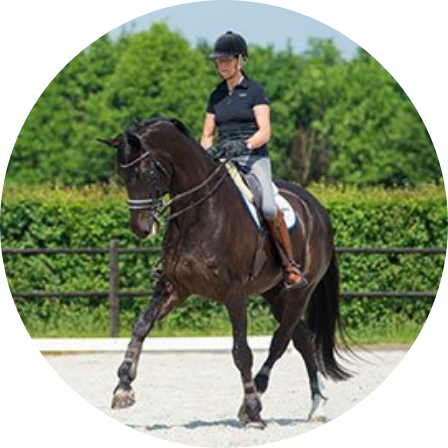
In dressage, fatigue can occur during a specific movement. For example, a horse with good leg height in the piaffe, For example, a horse that has limbs but which gradually gets lower is probably fatigued. Alternatively, a horse that scores a 9 for extended trot at the beginning of a test but only a 6 for the same movement later in the test does so because of developing fatigue. In jumping, many horses will begin to develop a certain amount of fatigue at the end of a round. This is because the muscles need a certain amount of time to recover between jumping efforts. The higher the jumps and the shorter the distance between them, the earlier fatigue occurs. And at the jumping can be expressed as something as subtle as simply touching a pole.
With endurance, we have an apparently much simpler situation. However, the fatigue in endurance comes after hours and is likely to be caused by energy depletion (glycogen) electrolyte loss, dehydration and part of the “brain” (central nervous system) fatigue. Fatigue in eventing during the cross-country phase is perhaps the most complex to try to understand. A prolonged period of galloping, slowing down before jumps, speeding up after jumps, the jump efforts themselves, hills, turns and water make all efforts highly variable. Good riders are generally those who can ride smoothly and therefore delay the first signs of fatigue.
Role of airways in fatigue
If muscles do not get an adequate supply of oxygen for the level of work then they begin to produce lactic acid. From studies of horses with mild respiratory problems trained on treadmills, we know that these horses will produce lactic acid at a slower rate and consequently fatigue earlier. While in untrained/not fit horses the heart and muscles limit performance , in trained/fit horses, the respiratory system is precisely the weakest link ! So it makes sense that even with a small loss of that function of the anterior airways or a larger problem (e.g. equine asthma, “bleeding” (EIPH)) that it would be significant negative effects on performance.What is worse for the lungs is that this often occurs without any indication of respiratory disease ( no cough, no abnormal noise and no runny nose).
One of the most common reasons why horses' respiratory systems do not perform optimally and thus can contribute to earlier fatigue is the presence of airway inflammationThis is usually due to inhalation of substances in the stables, which in turn come from fodder, feed and bedding. That includes :pollen, fungal spores, bacterial toxins (known as endotoxins) plant material or physical dust (e.g. small fragments of sand, soil, etc). Feed can be steamed to prevent inhalation of dust and rubber mats combined with less dusty bedding, such as large chip wood chips are two very good ways to improve the quality of air in your horse stable, not to mention good ventilation; it is better to keep doors and windows open at all times and put on some extra blankets.
Last but not least one of the main causes of materials that can lead to respiratory tract inflammation is BREAKINGWetting is of course one option but leads to loss of minerals, vitamins and soluble sugars. In addition, wetting can be time-consuming and it increases bacteria and mould after a certain time. EEP soaking ship clean. Many people have found that steaming hay, kills fungi and bacteria and significantly reduces dust while not affecting the nutritional quality of the forage.
Conclusion
When it comes to fatigue, the horse as a flight animal , is often willing to go further than a human athlete. One reason for this is that during hard training, levels of adrenaline in the horse's blood are about 10 times higher than ours, combined with high levels of endorphins (literally endogenous [within the body] morphine). Adrenaline and endorphins can help mask pain and allow the horse to strain themselves more than may be good for their own well-being. For this reason, it is important that riders recognise the signs of fatigue and know how to slow them down through appropriate training , preparation and way of riding. Just as the respiratory system plays a central role in ensuring oxygen supply to muscles, the lung system plays a central role in ensuring oxygen supply to muscles, the essential that present air quality is optimal.
More information

Rob Pijnappels
Owner of Equitrend